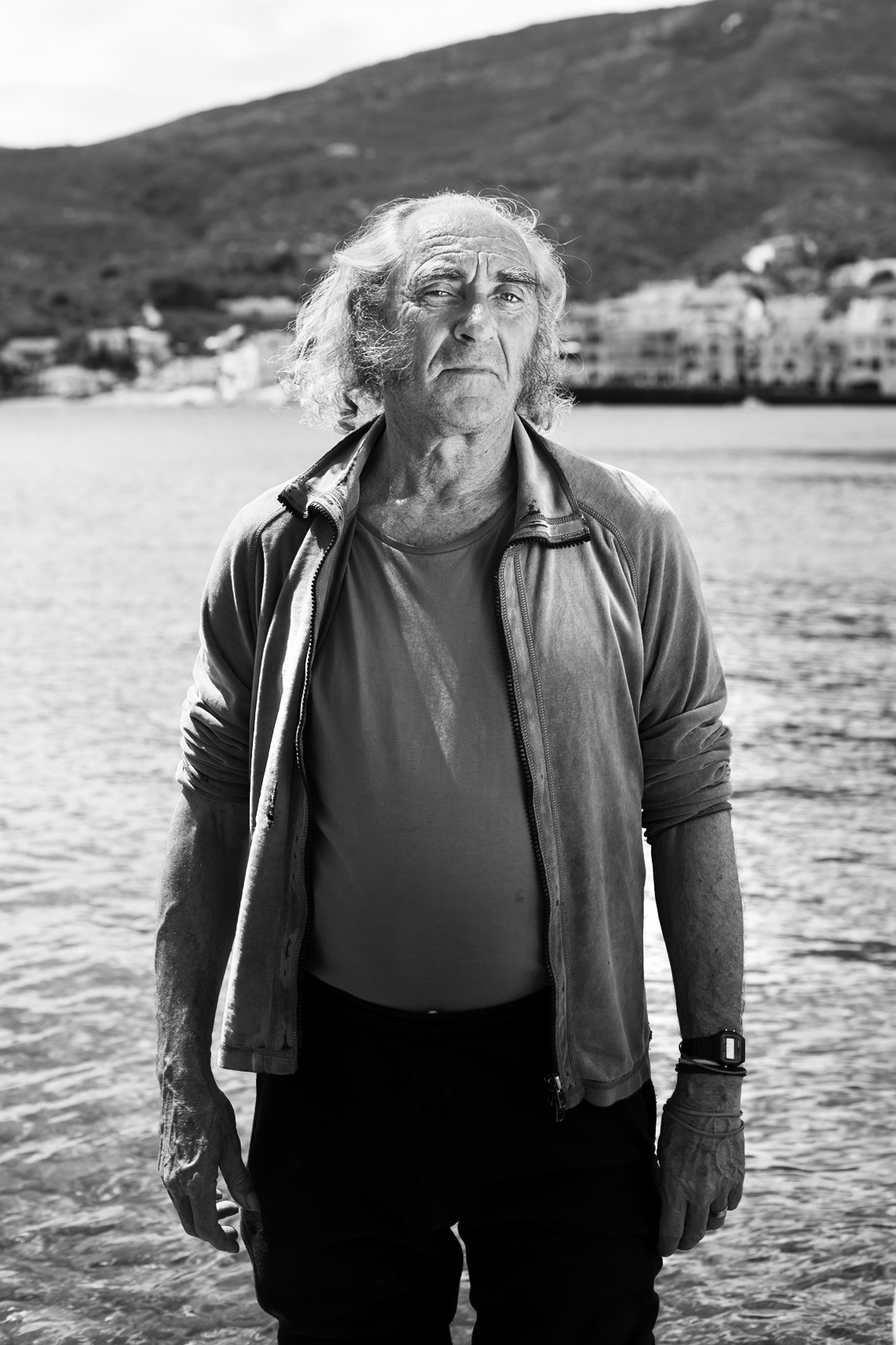
Pau Riba is known for his role as a musician and countercultural artist, as well as his bizarre and iconoclastic character (his album Dioptria is considered the twentieth century’s best album in Catalan), but he has also worked on essays, poetry, storytelling, graphic arts, critical journalism, performing arts, film... His latest essay La revolució que ara toca (The revolution now needed) (Pòrtic, 2016) gives us more thoughtful writings from Pau Riba. In its pages he describes how anti-ecological and poorly reasoned economic models are obsolete. And it gives alternatives for defending a new civilisation built on close ethical relationships with nature and a ceiling on wealth to redistribute it. “While there is even one in poverty, becoming rich should be a crime.”
We meet Pau on the terrace of Bar Galeón, in Cadaqués, the hometown of the Riba family and the village in which Sa meua mare (My mother) takes place, a book written in the form of a memoir in which he shares recent conversations with his mother Mercè Romeva. The story takes us with thrills and tenderness from Barcelona to the cool waters of the beach of Poal. “There came a time when the bedsores prevented her from getting up, but she wanted to return to Cadaqués. And I told her I will kidnap you, and for her it was no joke; one day when I went to her home, she had already arranged it... And once we arrived here the sickness left her, proving that the spirit is above matter!”
Yesterday in Cadaqués Les passanelles took place, the musical and poetic performance happening by the sea as stones are thrown on the water, making them jump. This has been orchestrated for the last twenty years by the architect Toni Gironès and, for this year, he has scheduled a concert with compositions by different musicians linked to the town, including Pau Riba. “You get a random melody and then you have to dress it, make it magnificent. It is a demonstration of how resourceful Catalans are.” He was commissioned to write a ‘classic piece’ and he says ironically: “I have done what I was asked to do, and I created a composition for string quartet and flute. Afterwards, I was told that everything can be a classic piece, even rock and roll.“
His creativity has no end. In the pipeline, he has a beautiful and experimental project to compose a musical work drawing on the similarity between a musical stave and the position of migratory birds on overhead electricity cables. Moreover, he just wrote the poetry collection Terra tremens, which was inspired by the 2015 earthquake, and is illustrated with engravings, which will be exhibited this summer at the Galeria Dieu. He tells us that, despite his forays into other arts, he considers himself a writer: “Literature has not posed me difficulties. It’s as if I had my grandfather inside... He was rigid and disciplined, but I have begun to turn literature into a game and I have fun playing with it. We should be able to replace the word work (treballar) with play (jugar), because work comes from the Latin word tripalium, meaning a Roman torture machine. Why should we earn a living? We should abolish money and advocate for a minimum income to ensure the sustainability of material conditions for everyone. We can only do this by putting a ceiling on wealth so that money flows to those who have less.” A new revised form of communism, he says. “Because, now, it is not only the men who work, but also, and above all, the machines. If the machine has replaced man, the yield of the machine should be for the worker, right? But it is not, it is for the owner of the machine. What grows endlessly is barbaric; because unlimited growth on a planet that is not unlimited in resources does not make sense at all. In nature everything grows, stabilises and decreases.”
We ask him about his vision of tourism and he said that he does not consider himself a tourist but a summer visitor. “Every time I come here it’s like I have come home. Cadaqués would not be what it is if in the fifties summer visitors from Barcelona had not made an agreement with the Council to preserve the town using natural and architectural planning measures (colours, materials, heights...). We can say that there are two opposing forces: tourists and summer visitors.” He believes that the days of compulsive tourism are numbered because of the depletion of fossil fuels and sees an era when “a plane will only be used once or twice in a lifetime”. I say that it seems a hopeful prediction, and at the height of noon, with the sun burning our necks and as we drink vermouth, we enter the realm of symbolism and macro-astrology, and he tells me that we are living in the transit between the age of Pisces, Christianity, and the age of Aquarius: “We are moving from an era of contradiction, sub-consciousness and opposed energies, to an era of super-consciousness and supermen. For this reason we need the return of man to nature. We need to embrace and recover the cyborg part of our nature which makes up 50% of ourselves. We cannot continue the conflict between the bio- and the techno-, but we must make ourselves aware of both forces and restore our relationship with nature. This was the key idea held by hippie utopians and we have to return to it.”
And at this point we close the conversation and walk to Poal to soak our feet in crystal waters, dodging dead jellyfish along the shore. “Now it is the jellyfish that eat the eggs of fish, and not vice versa. If we continue this way, we will get used to eating jellyfish instead of fish”//